• Member Login
  • Shopping Cart Shopping Cart
    0Shopping Cart
Oregon Seed Association
  • About Us
    • Members
    • Why Become a Member?
    • Officers & Board of Directors
    • Bylaws
    • Code of Ethics
  • Events
    • Events Calendar
    • Mid-Winter Meeting
    • Summer Convention
    • Cool Season Grass Workshop
  • Resources
    • OSA Seed Labeling Database
    • Seed Testing Labs
    • OSA Seed Lab Update
    • News
    • Legislative Reports
    • Palmer Amaranth
    • Industry Links
    • Commonly Used Acronyms
    • Stewardship Policy
  • Sponsors
  • Scholarship
    • Scholarship Award Recipients
  • Contact
  • Careers
    • Job Posts
    • Create a Job Post
    • Resume Posts
    • Create a Resume Post
  • Menu Menu
You are here: Home1 / Field burning starts early as heat hastens harvest

Field burning starts early as heat hastens harvest
July 10, 2015
SAL Periscope 0709

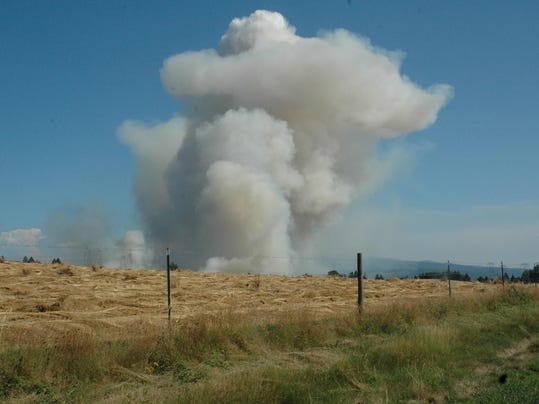
Field burning takes place at a grass seed field in the Lyons area in 2011. Field burning started Aug. 1 that year.(Photo: Statesman Journal file)

Field burning has kicked off early in Oregon’s Willamette Valley, as hot weather and drought conditions lead to an early grass seed harvest.

A test fire was conducted in the Silverton area Tuesday, with open field burning expected to follow.

“It’s probably two weeks earlier than a normal year,” said Roger Beyer, executive director of the Oregon Seed Council.

Grass seed is big business in Oregon, especially in the Willamette Valley counties of Linn, Benton and Marion.

Farmers burn fields to clear weeds and fight pests and erosion without chemical pesticides and herbicides.

But the plumes of smoke can enter communities, causing health problems and even traffic accidents.

As many as 200,000 acres per year were burned in the early 1980s, drawing thousands of complaints each year. Then, in August 1988, smoke caused low visibility on Interstate 5 near Albany, causing a massive pileup that killed seven people and injured 38.

In 1991, the Legislature established a phased-in cap on field burning of 40,000 acres per year.

And in 2009, lawmakers banned it entirely, except for a small area in Marion County, mostly near Silverton, where steep terrain and certain types of seed make alternatives difficult.

In the five years since, the industry has seen increased disease and pest problems, Beyer said.

“We predicted that and it’s coming true. The biggest one right now we’re facing is slugs,” he said. “We’re talking tens of millions of dollars of crop loss and treatment loss.”

Farmers also are using more chemicals, Beyer said.

Complaints, however, have fallen, from 3,783 in 1988 to just 76 last year, according to the Oregon Department of Agriculture, which regulates field burning.

The state only allows burning when conditions promise to lift smoke up and away from populated areas, said John Byers, the ODA program manager who oversees field burning.

And the State Fire Marshal bans field burning when two of three conditions exist: Temperature over 95 degrees, humidity of 30 percent or less, or winds of 15 miles per hour or greater, Byers said.

“We go to such lengths to monitor the weather,” he said. “If we issue a permit for a burn, they have one hour in which to light it.”

Last year, 12,304 acres were burned, and ODA estimates communities were impacted by smoke for a total of 30 hours.

Read the original article on the Statesman Journal here.

Share this entry
  • Share on Facebook
  • Share by Mail
https://oregonseed.org/wp-content/uploads/2025/04/osa-logo.png 0 0 Admin https://oregonseed.org/wp-content/uploads/2025/04/osa-logo.png Admin2015-07-10 16:04:152015-07-10 16:04:15Field burning starts early as heat hastens harvest

Archive

  • September 2024 (2)
  • August 2024 (1)
  • July 2024 (1)
  • June 2024 (2)
  • April 2024 (1)
  • March 2024 (1)
  • February 2024 (1)
  • July 2023 (1)
  • April 2023 (1)
  • December 2022 (1)
  • November 2022 (2)
  • June 2022 (1)
  • March 2022 (1)
  • February 2022 (1)
  • September 2021 (2)
  • August 2021 (2)
  • July 2021 (2)
  • May 2021 (3)
  • March 2021 (3)
  • February 2021 (1)
  • November 2020 (1)
  • September 2020 (1)
  • August 2020 (1)
  • July 2020 (2)
  • June 2020 (1)
  • December 2019 (1)
  • October 2019 (1)
  • July 2019 (1)
  • May 2019 (2)
  • March 2019 (1)
  • December 2018 (1)
  • August 2018 (1)
  • January 2018 (1)
  • October 2017 (1)
  • September 2017 (1)
  • August 2017 (4)
  • June 2017 (3)
  • May 2017 (1)
  • April 2017 (1)
  • March 2017 (1)
  • February 2017 (1)
  • October 2016 (2)
  • August 2016 (2)
  • June 2016 (2)
  • May 2016 (2)
  • March 2016 (2)
  • January 2016 (1)
  • December 2015 (3)
  • November 2015 (1)
  • October 2015 (1)
  • September 2015 (3)
  • August 2015 (1)
  • July 2015 (6)
  • June 2015 (2)
  • May 2015 (5)
  • April 2015 (4)
  • March 2015 (3)
  • February 2015 (4)
  • January 2015 (3)
  • December 2014 (3)
  • November 2014 (1)
  • October 2014 (5)
  • September 2014 (1)
  • August 2014 (5)
  • July 2014 (4)
  • June 2014 (1)
  • May 2014 (2)
  • April 2014 (4)
  • March 2014 (3)
  • February 2014 (4)
  • January 2014 (7)
  • December 2013 (5)
  • November 2013 (2)
  • October 2013 (3)
  • September 2013 (5)
  • August 2013 (8)
  • July 2013 (5)
  • June 2013 (10)
  • May 2013 (7)
  • April 2013 (1)
  • March 2013 (2)
  • March 2012 (1)
  • June 2010 (1)
  • May 2010 (1)

New Members

  • Application
  • Bylaws
  • Antitrust Statement
  • Why Become a Member?

Contact

[email protected]
PO Box 262
Tangent, OR 97389

© Copyright - Oregon Seed Association | Privacy Policy
Link to: Grass seed suffers from drought, heat Link to: Grass seed suffers from drought, heat Grass seed suffers from drought, heat Link to: OSA EXECUTIVE DIRECTOR TO JOIN NATIONAL SEED ORGANIZATION Link to: OSA EXECUTIVE DIRECTOR TO JOIN NATIONAL SEED ORGANIZATION OSA EXECUTIVE DIRECTOR TO JOIN NATIONAL SEED ORGANIZATION
Scroll to top Scroll to top Scroll to top