Columbia River Seed Harnesses Automation, Genetics to Enhance Production
While most grass seed produced in Oregon comes from the rainy and fertile Willamette Valley, it is not the only region yielding high-quality seed crops.
Established in 2003, Columbia River Seed supplies Kentucky bluegrass, perennial ryegrass, tall fescue, and fine fescue grown on both sides of the Columbia River in Eastern Oregon and Washington. The company markets its products through a strategic partnership called Columbia River Basin Seed Trinity, formed in 2023 with Riverview Seed Co. based in Hermiston.
“We’ve transformed from just third-party multiplication and selling seed to a wholesale customer, to now we’re a value-added business,” said Cody Gyllenberg, Operations Manager for Columbia River Seed. “We grow seed, we blend seed, we market seed … we have customers across the globe that all require different things.”

Cody Gyllenberg (right), Dallin Iverson (Field Manager, left), and Jory Iverson (Seed Stock Manager, center) planting observation plots at Columbia River Seed.
Being situated in the heart of the Columbia Basin comes with its own set of unique challenges. For starters, the climate is much drier, meaning access to irrigation is critical. Secondly, most farmers grow grass seed secondarily as a rotation crop between plantings of higher-value vegetables like potatoes and onions.
In order to make grass seed economically competitive, Gyllenberg said Columbia River Seed has leaned heavily into automating its cleaning and packaging facilities in Plymouth, Wash., and testing newer, better-performing varieties.
Along with automating its cleaning and packaging lines, growers for Columbia River Seed are also experimenting with laser-fired weeders in place of hand-rogueing crews to save on labor.
“I’ve done the math,” Gyllenberg said. “Let’s put it this way — as expensive as (automation) is, we can justify it in a few years just on our labor costs.”
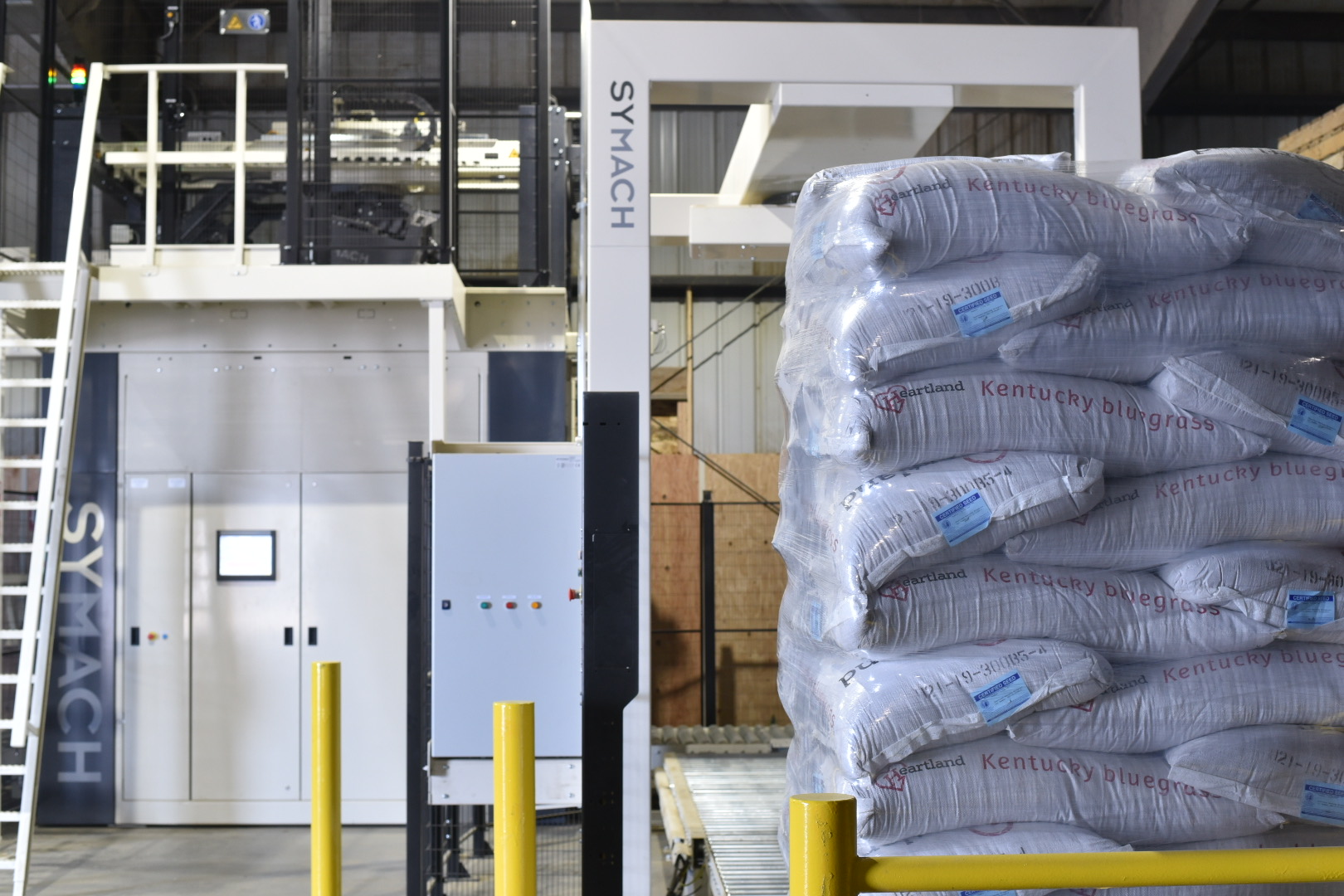
Packaged bags of Kentucky bluegrass are ready to ship at Columbia River Seed in Plymouth, Wash.
Law of Constant Misery
Gyllenberg, who graduated from Washington State University with a degree in agronomy, has a special passion for plant breeding.
Columbia River Seed works closely with the Willamette Valley-based Novel AG Inc. to do variety development. Novel AG tests thousands of grass cultivars, paying close attention to qualities such as wear-tolerance, early spring green-up, and post-harvest dormancy. Only a small fraction will make the final cut.
“We do have some new varieties that are pushing the envelope very hard, and that we’re excited about,” he said.
Plant breeding is both a science and an art, Gyllenberg said. Sometimes, a variety produces excellent yields but is lower in turf quality. Other times, the turf quality is superb, but yields aren’t up to par.
Gyllenberg calls it “the law of constant misery.”
“We try not to aimlessly release varieties,” Gyllenberg said. “As any good business grows and develops, you try to refine the tip of your spear, and you’re picking things that are not just another option, but always a better option.”

A field of Sierra Vista Sheep Fescue grows in the Columbia Basin.
Industry Unity
Columbia River Seed has been a member of OSA since its founding, which Gyllenberg said has provided a fantastic outlet to connect with industry partners and develop working relationships.
Though the seed industry is diverse, Gyllenberg said OSA should be the glue that holds everyone together by uniting around common goals and issues.
“Today’s modern OSA could potentially be a pillar and an innovator in our own right,” Gyllenberg said. “In order to do that, I think it’s key to drive hard on the most important big-picture and philosophical issues that plague our industry. If we can find a way to unite members around those important pillars of ideology, then the smaller issues become less frustrating.
“None of that can happen overnight,” he added, “but if the underlying motif is there, then the roadmap is traversable.”
Want to see more photos and videos from Columbia River Seed? Be sure to check out the company’s Instagram pages, @ColumbiaRiverSeed and @SeedTrinity. For more information or to contact Columbia River Seed, click here.

The 2024 grass seed harvest is mostly complete for Columbia River Seed in Eastern Oregon and Washington.