• Member Login
  • Shopping Cart Shopping Cart
    0Shopping Cart
Oregon Seed Association
  • About Us
    • Members
    • Why Become a Member?
    • Officers & Board of Directors
    • Bylaws
    • Code of Ethics
  • Events
    • Events Calendar
    • Mid-Winter Meeting
    • Summer Convention
    • Cool Season Grass Workshop
  • Resources
    • OSA Seed Labeling Database
    • Seed Testing Labs
    • OSA Seed Lab Update
    • News
    • Legislative Reports
    • Palmer Amaranth
    • Industry Links
    • Commonly Used Acronyms
    • Stewardship Policy
  • Sponsors
  • Scholarship
    • Scholarship Award Recipients
  • Contact
  • Careers
    • Job Posts
    • Create a Job Post
    • Resume Posts
    • Create a Resume Post
  • Menu Menu
You are here: Home1 / 50 Objects: In mid-valley, grass seed makes the word go ’round

50 Objects: In mid-valley, grass seed makes the word go ’round
July 1, 2014
grassseed
 

By Alex Paul, Albany Democrat-Herald

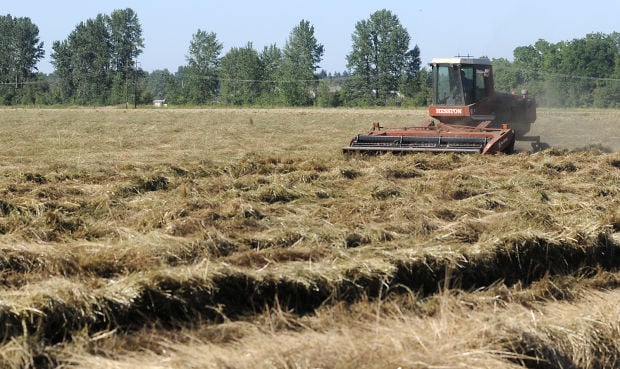
Little did Tangent-area farmer Forest Jenks know when he planted the first commercial ryegrass crop in the mid-valley in 1921 that nearly 100 years later, grass seed would be sold around the world and that Linn County would be known as the “Grass Seed Capital of the World.”

For for more than 90 years, Linn County farmers have produced grass seed that is coveted for everything from golf courses to farm pastures.

The mid-valley’s temperate climate and wet winters provide ideal conditions for both turf and forage grasses, resulting in annual combined sales of more than $300 million, Oregon’s fifth largest crop in terms of economics.

Turf grass seed is used for lawns, athletic fields and golf courses, including the fields in the World Cup soccer tournament being played now in Brazil.

Forage grass seed is used for pastures, roadsides and soil erosion control.

In total, the grass seed industry generates an estimated $1 billion annually to Oregon’s economy. Oregon’s grass seed farmers produce two-thirds of the cool season grass seed in the world.

By the 1940s, new grass varieties had been developed, and the industry blossomed.

Now, Oregon has an estimated 1,500 grass seed farmers, the majority of whom are based in Linn, Benton, Polk and Marion counties. They employ more than 10,000 people and there are nearly 400 seed conditioning plants throughout the Willamette Valley.

More than 500,000 acres of Oregon land is devoted to grass seed production, with more than 420,000 acres in the Willamette Valley.

Farmers produce more than 700 million pounds of cool season grass seed annually.

Key grass seed varieties are: ryegrass, annual ryegrass, tall fescue, bentgrass, fine fescue, Kentucky bluegrass and orchardgrass.

Oregon State University is a major source of research for the grass seed industry, with much of that research conducted at the Hyslop Research Station between Albany and Corvallis.

The original article published in the Albany Democrat Herald on 7/1/14 can be found here.

Share this entry
  • Share on Facebook
  • Share by Mail
https://oregonseed.org/wp-content/uploads/2025/04/osa-logo.png 0 0 Admin https://oregonseed.org/wp-content/uploads/2025/04/osa-logo.png Admin2014-07-01 12:10:382014-07-01 12:10:3850 Objects: In mid-valley, grass seed makes the word go ’round

Archive

  • September 2024 (2)
  • August 2024 (1)
  • July 2024 (1)
  • June 2024 (2)
  • April 2024 (1)
  • March 2024 (1)
  • February 2024 (1)
  • July 2023 (1)
  • April 2023 (1)
  • December 2022 (1)
  • November 2022 (2)
  • June 2022 (1)
  • March 2022 (1)
  • February 2022 (1)
  • September 2021 (2)
  • August 2021 (2)
  • July 2021 (2)
  • May 2021 (3)
  • March 2021 (3)
  • February 2021 (1)
  • November 2020 (1)
  • September 2020 (1)
  • August 2020 (1)
  • July 2020 (2)
  • June 2020 (1)
  • December 2019 (1)
  • October 2019 (1)
  • July 2019 (1)
  • May 2019 (2)
  • March 2019 (1)
  • December 2018 (1)
  • August 2018 (1)
  • January 2018 (1)
  • October 2017 (1)
  • September 2017 (1)
  • August 2017 (4)
  • June 2017 (3)
  • May 2017 (1)
  • April 2017 (1)
  • March 2017 (1)
  • February 2017 (1)
  • October 2016 (2)
  • August 2016 (2)
  • June 2016 (2)
  • May 2016 (2)
  • March 2016 (2)
  • January 2016 (1)
  • December 2015 (3)
  • November 2015 (1)
  • October 2015 (1)
  • September 2015 (3)
  • August 2015 (1)
  • July 2015 (6)
  • June 2015 (2)
  • May 2015 (5)
  • April 2015 (4)
  • March 2015 (3)
  • February 2015 (4)
  • January 2015 (3)
  • December 2014 (3)
  • November 2014 (1)
  • October 2014 (5)
  • September 2014 (1)
  • August 2014 (5)
  • July 2014 (4)
  • June 2014 (1)
  • May 2014 (2)
  • April 2014 (4)
  • March 2014 (3)
  • February 2014 (4)
  • January 2014 (7)
  • December 2013 (5)
  • November 2013 (2)
  • October 2013 (3)
  • September 2013 (5)
  • August 2013 (8)
  • July 2013 (5)
  • June 2013 (10)
  • May 2013 (7)
  • April 2013 (1)
  • March 2013 (2)
  • March 2012 (1)
  • June 2010 (1)
  • May 2010 (1)

New Members

  • Application
  • Bylaws
  • Antitrust Statement
  • Why Become a Member?

Contact

[email protected]
PO Box 262
Tangent, OR 97389

© Copyright - Oregon Seed Association | Privacy Policy
Link to: Rural Oregon, meet Portland Link to: Rural Oregon, meet Portland Rural Oregon, meet Portland Link to: GMO crops can’t be monitored or regulated in Oregon Link to: GMO crops can’t be monitored or regulated in Oregon GMO crops can’t be monitored or regulated in Oregon
Scroll to top Scroll to top Scroll to top