• Member Login
  • Shopping Cart Shopping Cart
    0Shopping Cart
Oregon Seed Association
  • About Us
    • Members
    • Why Become a Member?
    • Officers & Board of Directors
    • Bylaws
    • Code of Ethics
  • Events
    • Events Calendar
    • Mid-Winter Meeting
    • Summer Convention
    • Cool Season Grass Workshop
  • Resources
    • OSA Seed Labeling Database
    • Seed Testing Labs
    • OSA Seed Lab Update
    • News
    • Legislative Reports
    • Palmer Amaranth
    • Industry Links
    • Commonly Used Acronyms
    • Stewardship Policy
  • Sponsors
  • Scholarship
    • Scholarship Award Recipients
  • Contact
  • Careers
    • Job Posts
    • Create a Job Post
    • Resume Posts
    • Create a Resume Post
  • Menu Menu
You are here: Home1 / ninja_forms_preview_page2 / 20153 / June

Media Release: Sprague Pest Solutions Named A Top 100 Company

June 19, 2015

MEDIA RELEASE: Sprague Pest Solutions Named A Top 100 Company

Sprague’s Next Generation of Leaders Recognized by NPMA

Tacoma, Wash. (June 19, 2015) – Tacoma-based Sprague Pest Solutions (www.spraguepest.com) moved up one spot to 28th on the 2015 Pest Control Technology magazine Top 100 List, an annual compilation of the leading pest management companies in the United States. The list was included in the magazine’s May issue (www.pctonline.com).

Sprague, a fourth-generation, family-owned company, is part of a nationwide industry that generated an estimated $7.4 billion in revenue in 2014 – a 3.5 percent increase from the previous year – and that has experienced consistent growth over the last five years.

The company provides vital preventive and remedial pest management and consulting services to leading food processing, healthcare, hospitality, education, agriculture, education and multi-family housing facilities in the Pacific Northwest and Western Mountain regions. It operates service centers in Washington, Oregon, Idaho, Utah and Colorado.

In addition to protecting clients’ facilities from pests including rodents, ants, cockroaches, bed bugs, nuisance birds, stinging insects, stored product pests, and flies, Sprague offers specialty technical services including heat treatments, fumigations, fumigation alternatives, large-scale bird exclusion and employee training.

“We are proud and humbled to once again be named to PCT magazine’s Top 100 List,” says Alfie Treleven, CEO and president of Sprague Pest Solutions. “Being named to the list is more than just securing a position or ranking, it is a reflection of more than eight decades of consistently delivering quality, innovative pest management services to our valued commercial and residential clients, and investing in exceptional people to care for these clients.”

The company also announced that two if its next generation of leaders – Ross Treleven and AJ Treleven – have been recognized by the National Pest Management Association as members of the Next Generation of Leaders in the Pest Management Industry. Ross is district manager for Sprague with responsibility for the company’s Seattle, Salt Lake City and Denver service centers. AJ is the service center manager for the company’s Utah operations. The pair was profiled in the May/June issue of Pestworld magazine (www.npmapestworld.org).

Sprague Pest Solutions, founded in 1926, is a Copesan Services partner (www.copesan.com).

# # #

Media Contact:
Carrie Thibodeaux
Sprague Pest Solutions
253.405.2590 / [email protected]   
https://oregonseed.org/wp-content/uploads/2025/04/osa-logo.png 0 0 Admin https://oregonseed.org/wp-content/uploads/2025/04/osa-logo.png Admin2015-06-19 11:00:262015-06-19 11:00:26Media Release: Sprague Pest Solutions Named A Top 100 Company

Young farmers from New Zealand, Tasmania visiting mid-valley

June 18, 2015

061815-adh-nws-farm-tour-2-ap.jpg

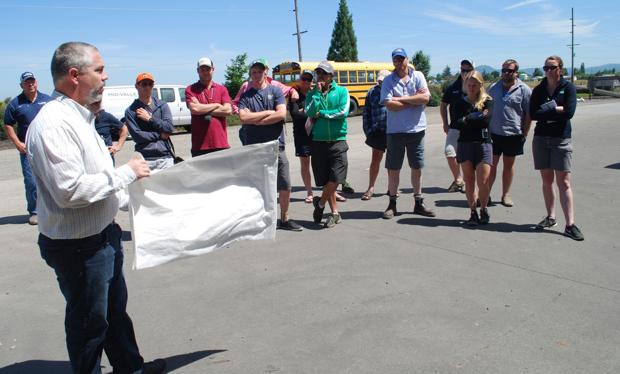
Arlis Mishler, general manager of Smith Seed Services’ bag division in Halsey, talks about determining quality for the millions of bags the company sells each year. Smith Seed provides bags for grass seed, feed, grain, produce, nuts, bird seed, wild game seed, pet food, sand, fertilizer, chemicals, wood pellets, rock, dirt and emergency flood use.

Seventeen young farmers from New Zealand and Australia toured mid-valley farms and agribusinesses Wednesday, hoping to pick up pointers to use in their own farm and ranch operations.

The group, composed primarily of members of the Foundation for Arable Research (FAR) in Templeton, New Zealand, will spend three weeks in the United States with stops in Oregon, Iowa, Illinois, Kentucky, and North and South Carolina.

The mid-valley tour was arranged by Halsey farmer James VanLeeuwen, who has made numerous ag-related trips to New Zealand over the years.

“The goal is to get them learning,” said FAR research manager Richard Chynoweth. “They really wanted to come to the States. We hope this helps upscale them and give them the confidence needed to grow their operations.”

According to Chynoweth, although similar crops are grown in Oregon and New Zealand, including wheat and grass seed, farms are much smaller in New Zealand.

The group arrived in Portland on Saturday and has been winding its way to the mid-valley, spending time in Amity and Silverton en route.

Wednesday’s tour included stops at Crop Production Services in Tangent, Mike and Tami Coon’s Oak Park Farms near Shedd, Smith Seed in Halsey, lunch at Larry and Margaret Warfel’s farm on Peoria Road, Ore Pac straw processing in Junction City, field tiling by Dave Neal, OSU Hyslop Research Station, and supper at Eats and Treats in Philomath.

Felicity Mason, 31, lives on a 6,000-acre farm and ranch in Tasmania.   She hopes to learn how American farmers can make larger, more expensive equipment work financially.

“We raise sheep and beef cows, plus some crops,” she said. “I’m interested in the economies of scale. How you can tie up so much money in equipment and make it work?”

Mason is touring on her own and connected with the FAR tour through VanLeeuwen.

“I’m really interested in field tilling,” she said. “I want to stay long enough to see some of the harvest, and then I’m meeting a friend and we’re going to tour central and eastern Oregon.”

Mason is also impressed that although farms here are larger in scale, they’re still primarily owned by families, not out-of-state corporations.

“That’s not always an easy thing to do,” she said.

Craig Clucas, 29, farms about 400 acres and raises rye, wheat, barley and kale that is used to feed dairy cattle. “We have a few sheep, too,” he said.

The Templeton area, which is near Christchurch, gets about 30 inches of rain annually and some crops are irrigated, much like the mid-valley.

“I’m picking up some ideas,” he said. “I really wanted to experience America, especially meet rural people.”

Stephen Blain and Tom Copland, both 27, said they were enjoying their visit, but said their farming area is much smaller than the Willamette Valley’s.

“We’re bordered by mountains and the ocean,” Blain said. “We grow wheat, grass seed, peas, radishes, spinach and hemp.”

Blain said 2,000 acres would be a big farming operation in his area of New Zealand.

“The average is probably 700 to 800 acres,” he said.

Read the original article here on Corvallis Gazette-Times here.

https://oregonseed.org/wp-content/uploads/2025/04/osa-logo.png 0 0 Admin https://oregonseed.org/wp-content/uploads/2025/04/osa-logo.png Admin2015-06-18 11:44:382015-06-18 11:44:54Young farmers from New Zealand, Tasmania visiting mid-valley

Archive

  • September 2024 (2)
  • August 2024 (1)
  • July 2024 (1)
  • June 2024 (2)
  • April 2024 (1)
  • March 2024 (1)
  • February 2024 (1)
  • July 2023 (1)
  • April 2023 (1)
  • December 2022 (1)
  • November 2022 (2)
  • June 2022 (1)
  • March 2022 (1)
  • February 2022 (1)
  • September 2021 (2)
  • August 2021 (2)
  • July 2021 (2)
  • May 2021 (3)
  • March 2021 (3)
  • February 2021 (1)
  • November 2020 (1)
  • September 2020 (1)
  • August 2020 (1)
  • July 2020 (2)
  • June 2020 (1)
  • December 2019 (1)
  • October 2019 (1)
  • July 2019 (1)
  • May 2019 (2)
  • March 2019 (1)
  • December 2018 (1)
  • August 2018 (1)
  • January 2018 (1)
  • October 2017 (1)
  • September 2017 (1)
  • August 2017 (4)
  • June 2017 (3)
  • May 2017 (1)
  • April 2017 (1)
  • March 2017 (1)
  • February 2017 (1)
  • October 2016 (2)
  • August 2016 (2)
  • June 2016 (2)
  • May 2016 (2)
  • March 2016 (2)
  • January 2016 (1)
  • December 2015 (3)
  • November 2015 (1)
  • October 2015 (1)
  • September 2015 (3)
  • August 2015 (1)
  • July 2015 (6)
  • June 2015 (2)
  • May 2015 (5)
  • April 2015 (4)
  • March 2015 (3)
  • February 2015 (4)
  • January 2015 (3)
  • December 2014 (3)
  • November 2014 (1)
  • October 2014 (5)
  • September 2014 (1)
  • August 2014 (5)
  • July 2014 (4)
  • June 2014 (1)
  • May 2014 (2)
  • April 2014 (4)
  • March 2014 (3)
  • February 2014 (4)
  • January 2014 (7)
  • December 2013 (5)
  • November 2013 (2)
  • October 2013 (3)
  • September 2013 (5)
  • August 2013 (8)
  • July 2013 (5)
  • June 2013 (10)
  • May 2013 (7)
  • April 2013 (1)
  • March 2013 (2)
  • March 2012 (1)
  • June 2010 (1)
  • May 2010 (1)

New Members

  • Application
  • Bylaws
  • Antitrust Statement
  • Why Become a Member?

Contact

[email protected]
PO Box 262
Tangent, OR 97389

© Copyright - Oregon Seed Association | Privacy Policy
Scroll to top Scroll to top Scroll to top